

Service level is a key KPI in contact centers that directly impacts service quality, productivity, cost efficiency, and your company’s brand reputation. Monitoring and consistently optimizing service levels is crucial for the operational success of your contact center. In this blog, we’ll explore:
- What is service level in contact centers?
- How can you calculate service level?
- 5 best strategies to improve service level in your contact center
What is service level in contact centers?
Service level is a critical metric which indicates how accessible your contact center is, as well as the overall quality of your resource planning. It’s one of the most important KPIs in the contact center industry. A common industry benchmark is the 80/20 service level, meaning 80% of calls are answered within 20 seconds.
This target originated from an AT&T contact center study in the 1980s, discovering that most callers would hang up after 20 seconds. Although technology has evolved with queue music and IVR since then, the 80/20 goal is still widely practiced in inbound contact centers.
Example: If your contact center receives 100 calls in an hour, and 80 are answered within 20 seconds, you’re meeting the 80/20 service level benchmark.
How can you calculate service level?
To calculate service level for your contact center, you need the following data:
- Wait time for each call
- Total number of calls (including answered, abandoned, and busy signals)
Here is the service level formula:
Service Level (%)=Number of calls answered within target time/ Total number of calls×100
Example: If 80 out of 100 calls are answered within 20 seconds, your service level is 80%.
.png?width=800&height=544&name=call-center-kpis%20(4).png)
Download this eBook to learn about the most important KPIs relevant to contact centers, and how you can properly measure and interpret them to make informed decisions.
Strategies to improve service level in your contact center
The following best practices are proven methods to increase service levels, improve customer satisfaction, and optimize operational efficiency.
1. Optimize your workforce management process
To consistently achieve target service levels, every step of the workforce management (WFM) process: forecasting, scheduling, intraday management, and reporting, is crucial. An effective WFM process significantly impacts your contact center's key performance indicators and overall success. It helps to increase efficiency and productivity while reducing costs and optimizing staff utilization. The latter is an essential factor in achieving service level targets.
If your contact center is understaffed, meaning there are too few agents on-site, wait times will increase, resulting in a drop in service levels. If, on the other hand, there are too many agents on-site, the service level will increase, but unnecessary additional costs will arise.
A robust WFM strategy ensures the right agents with the right skills are scheduled at the right times to maintain high service quality.
Tips to enhance your WFM process:
- Identify weak points in your processes (e.g., understaffing, overstaffing, inefficient break planning, lack of intraday tactics)
- Align workforce management with overall contact center goals
- Assign a dedicated person or team for workforce management
- Regularly assess your tools and consider advanced WFM software for full process automation
With modern WFM software, you can automate and optimize all WFM processes from forecasting to scheduling. This can positively impact service level and agent performance.
Here is a quick checklist to ensure you are working with the right WFM technology.
2. Improve forecast accuracy to achieve service level goals
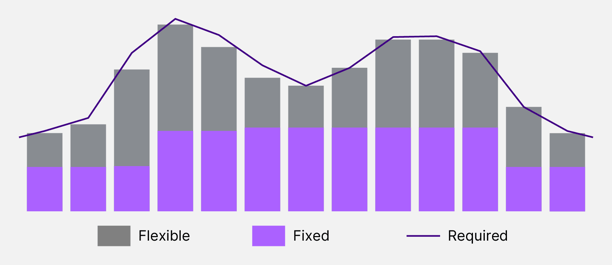
Accurate forecasting is the foundation of successful workforce management and a key factor in achieving service level goals. Missed service levels often result from poor and inaccurate forecasting. To meet your targets, it's essential to know exactly how many employees you need for each channel (e.g., inbound, back office, chat, etc.) throughout the day, week, or month. Reliable forecasts use historical volume and handle time data to predict staffing needs across all channels.
Tips for building accurate forecasts:
- Analyze patterns in historical data
- Factor in upcoming events (promotions, marketing campaigns)
- Account for leave and seasonal fluctuations
- Ensure data used for forecasts is accurate; flawed data leads to bad forecasts
- Leverage forecasting software and machine learning for daily, weekly, and yearly predictions
Direct integration between your WFM software and automatic call distribution (ACD) systems enables real-time forecasting based on live data, further improving service level accuracy. With modern, AI-powered forecasting tools, planners can create highly accurate daily, weekly, and annual forecasts, ensuring informed decisions and consistent service level performance.
3. Increase schedule efficiency and adherence
Efficient scheduling helps you maintain service level goals by reducing periods of overstaffing and understaffing, based on demand from your forecasts. Achieving this can be challenging in today’s omnichannel environment, where customers switch seamlessly between channels, creating multiple areas where service levels need to be maintained. One of the biggest drivers of a positive experience is delivering consistent service levels on all channels, which a well-planned omnichannel strategy can support.
When defining your scheduling strategy, here are a few common pitfalls to avoid:
- Creating too many rigid shifts and not enough flexible scheduling options
- Ignoring shrinkage (non-productive agent time)
- Underutilizing part-time staff and short shifts
- Not measuring planning efficiency
- Assuming no one wants unpopular hours (some employees prefer evenings and weekends)
After creating optimized schedules, it’s important to ensure your agents adhere to them. Plan adherence is just as critical as schedule efficiency. Even small deviations from the schedule, like taking longer breaks, can negatively affect service levels. Modern WFM software helps identify real-time gaps in coverage so managers can respond proactively.
However, it’s important to keep in mind while no schedule can achieve 100% adherence due to human factors like unplanned absences, a robust WFM approach can minimize their impact and stabilize service levels.

Download our WFM Benchmark Report to get more insights on why it's important to measure schedule efficiency for contact centers and its impact on service levels.
4. Improve intraday management
Effective intraday (real-time) management has a direct impact on service levels. This involves monitoring incoming contact volumes, handling times, and schedule adherence throughout the day.
Best practices for effective intraday management:
- Track schedule adherence for teams and individuals
- Adjust schedules ad hoc
- Set service level thresholds and get instant alerts for deviations, so you can react swiftly
- Document clear corrective actions to be triggered automatically if service levels drop
|
Service Level |
Measures |
|
Over 90% |
Offer to reduce overtime |
|
82-89% |
Schedule more coaching or training |
|
78-82% |
Stop less important back office activities |
|
Under 70% |
Use all available resources |
Modern WFM dashboards provide instant visibility into metrics such as average speed of answer (ASA), average handle time (AHT), call volumes, and staffing. This enables managers to take real-time action and maintain service level targets.
5. Reduce agent turnover
Lowering agent attrition dramatically reduces costs in recruiting and training. According to ProcedureFlow's June 2021 Market Research Report, contact centers with an average of 100 agents, who require 6-12 weeks of training and onboarding, can face projected costs ranging from $115,200 to $345,600. This figure includes only agent salaries and excludes costs such as trainer salaries, personnel, and IT costs.
High turnover also erodes productivity and staff morale and leads to the loss of experienced agents.
High turnover impacts your contact center in several ways:
- Fewer staff are available to answer calls, respond to emails, or handle chats, which directly affects your service levels
- The contact center becomes vulnerable to frequent understaffing
- Agents are overworked due to uneven distribution of work
- Overwork can also lead to reduced morale, increased absenteeism, and ultimately to further fluctuations, creating a vicious cycle
Tips to reduce turnover:
- Understand why agents leave and gather ongoing feedback (NPS surveys, 1:1 meetings)
- Make sure agents can take breaks and vacations to avoid burnout
- Allow flexible work options, including remote work
- Provide training, skill development, and clear career paths
- Regularly invest in employee satisfaction since happy staff drive happier customers
Low turnover leads to increased productivity and higher employee satisfaction. Furthermore, it is crucial to retain well-trained and highly qualified specialists, because when an employee leaves, this knowledge is lost.
Conclusion
Consistently achieving high service levels in contact centers is challenging but attainable. Meeting your service level goals requires:
- Continuous optimization
- Technology adoption
- Proactive management
To see lasting improvements, it's important to experiment with different approaches and adopt the ones that work best in your contact center. The strategies outlined above provide a solid starting point for improved service levels, customer satisfaction, and operational efficiency.
How Peopleware's enabled Thomas Cook Group to improve service level

"Not only have we dramatically improved customer service levels, we’ve reduced agent burnout and we’re saving over £100k a year."
 Kerry Turney,
Resource Planning Manager