AI (artificial intelligence) continues to be big news. There is no shortage of opinion about whether AI represents a boon to society, a new industrial revolution, whether it presages the end of civilization as we know it, or all of the above. There is great uncertainty about what an AI-powered future holds for individuals, businesses, and governments. What is certain is that nearly every software vendor is jumping on the AI bandwagon. Workforce management (WFM) vendors are no exception and there is currently a lot of hype about AI in WFM.
To make matters worse, many vendors are conflating basic WFM features with artificial intelligence in an attempt to capitalize on the buzz around AI. Undoubtedly, there are several potentially great applications of genuine AI in workforce planning. But to what extent is that potential already being realized or likely to be realized in the foreseeable future? And how many of the claims being made for AI would - whisper it - be delivered better by other technologies?
This blog post aims to take an honest look at AI in the context of WFM. How is AI already being applied to WFM, what AI-driven (and non-AI-driven) innovations should you look out for, and what is pure hype?
What exactly is AI?
Artificial Intelligence is a technology designed to enable machines to perform tasks that previously could only be performed by human intelligence. The launch of ChatGPT in late 2022 did more than any previous AI innovation to bring AI to public attention. But ChatGPT, DALL. E, Whisper, Google Gemini (formerly Bard), Midjourney, etc. are examples of generative AI, which is just one category of artificial intelligence.
AI is subject to continuous innovation, but this diagram summarises how some common forms of AI fit together.
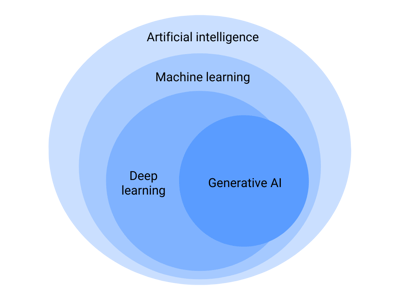
- Artificial intelligence is technology designed to enable machines to perform tasks that previously could only be performed by human intelligence
- Machine learning is a subset of AI that uses algorithms to enable computers to learn from and make predictions or decisions based on data
- Deep learning is a subset of machine learning that uses neural networks with multiple layers to learn representations of data
- Generative AI uses machine learning and deep learning techniques to generate new content that resembles the data it was trained on. Text generation is a subset of generative AI that uses Large Language Models to create new language content.
AI in WFM today
Fun fact: When you use Apple Siri, Google Assistant, or Amazon Alexa, you are using AI. Another fun fact: Your current WFM application may already be using AI as well.
Artificial intelligence in WFM forecasting
Currently, the main application of AI in WFM is in forecasting with predictive AI. WFM applications such as Peopleware use machine learning algorithms to analyze historic contact data, identify patterns at interval, week, season, and yearly levels and then make predictions down to interval level for a complete year into the future. The algorithms are always on, digesting new data as it becomes available, constantly learning and determining which forecasting methods generate the most accurate results.
Artificial intelligence in WFM scheduling
WFM has always been rooted in the discipline of operations research (OR), which is about the application of analytical techniques to improve decision-making. OR techniques such as simulation, stochastic modeling, and linear programming all have applications in workforce planning. For example, schedule optimization shifts through billions of permutations of possible shifts to find schedules that optimize coverage of customer demand with the supply of employees, while respecting all relevant constraints. If that sounds like artificial intelligence to you, you aren’t far off: while OR can be considered a distinct mathematical discipline, the boundaries between OR and AI is blurry. WFM vendors such as Peopleware have been using this technology maturely in production since 1996 and combine it skillfully with intelligent features and capabilities in the field of AI to optimize the entire scheduling process.
Artificial intelligence in WFM overall
For many years, good WFM applications have automated as much of the planning process as possible, freeing planners from tedious, repetitive, and error-prone work. Depending on the technology that is active in the background, the automation capabilities can range from simple deterministic rule execution to sophisticated autonomous process handling, decision-making and agentic intelligence. This might also include functionality that is more user-facing, such as the ability to interact with the WFM tool in natural language (like e.g. PIA, the Peopleware Intelligent Assistant, and similar products in the domain).
AI in WFM tomorrow
Some WFM software vendors are speculating about the benefits that AI could bring to the planning process. Much of this is hype, but in reality, AI has the potential to transform performance - and reduce user effort - in several parts of the WFM cycle. AI will enable forecasting to take into account many more input variables, for example, weather forecasts, and generate even more accurate predictions. AI-based real-time analytics have the potential to identify trends, patterns, and anomalies earlier than a human intraday manager, enabling corrective action to be taken before any damage is done. AI has the potential to dynamically and automatically adjust staffing schedules and task allocations in response to changing contact volumes, employee availability, and service level achievement.
Much of the current buzz around AI is about generative AI, driven by tools such as ChatGPT. In reality, the applications of generative AI in workforce management are limited. A potential application is in communication with scheduled employees. When that communication happens most naturally in conversational form, the user interface could be expanded using generative AI and large language models. Applications could include gathering schedule preferences, shift bidding, and shift swapping.
In general, the real advantage of AI in WFM is not new. Most of the value comes from applying machine learning in forecasting, shift optimization and OR in scheduling, and advanced automation. Rather than focusing on the latest chatbot - the most visual but often superficial use case - it is worth examining vendors’ actual expertise when looking for a WFM solution - e.g. by how long they have been using these capabilities successfully, and which problems they demonstrably solve.
Will AI steal your job?
AI has been described as the fourth industrial revolution, promising transformational improvements in productivity. It has the potential to free humans from mundane, repetitive tasks and enable them to focus on uniquely human endeavors. Generative AI supports the creative process by generating new content based on existing content that it has assimilated. Does that mean that the job of the planner will be taken by a machine? The short answer is NO. That’s partly because there are few worthwhile applications of generative AI within the planning process. And partly because AI, operations research, and automation will empower planners to be more efficient and effective, not replace them.
Rather than viewing AI as a threat, it's more realistic to see it as a tool that enhances the capabilities of human workers. While automation can handle repetitive tasks efficiently, it still lacks the nuanced understanding, empathy, and strategic thinking that human workforce planners bring to their roles. Instead of displacing human workers, AI can empower them to focus on higher-value activities. For instance, with AI handling the number-crunching aspects of planning, workforce planners can dedicate more time to strategic planning, coaching their colleagues, and addressing complex staffing challenges that require human judgment and creativity.
Examples of planning responsibilities that can’t be replaced by AI include:
- Business intelligence in forecasting; being aware of upcoming changes that can’t possibly be predicted from history
- Cross-departmental collaboration, e.g. planning:operations, planning:marketing
- Winning hearts and minds for planning innovations
Find out more
To see WFM software that leverages predictive AI, optimization AI and agentic AI in action today, meet with one of our WFM experts.